Recently in Grounded Category

I have had this printer for almost 4 years now. I have 2 kids in middle / high school who use it for homework, etc. Below is a running total cost of ownership. This printer has been very reliable, but I was a little surprised by how much it is costing me.


I've factored in the initial purchase cost (which I am somewhat estimating as I purchased it along with a few other goodies). That does raise the typical cost per page metric, but I figure that needs to be included as some printers are cheap and others not so much.

Also of interesting note - as of April 2013, I am STILL on the starter Magenta cartridge! (So my TCO is actually a little bit lower, as I have not put the new Magenta cartridge in).

My volumes are quite low ~ 2 pages / day. There are days where the printer sits idle, and then days when a school project gets printed a couple times as typos are noticed and corrected. I wonder how much ink would have been wasted from nozzles drying up due to idle during this time.
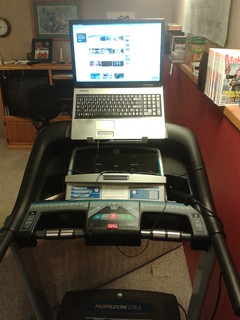
Latest winter project - a laptop stand for the treadmill.
Youtube on the tread mill
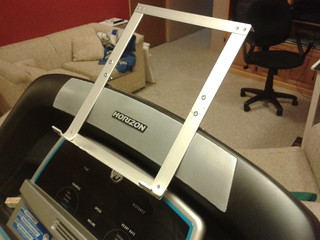
A simple frame of 2 vertical beams made from 1/8" x 1" aluminum flatbar, joined horizontally by 1/16" x 3/4" aluminum angle bars which was then attached to the top of the treadmill with a couple angle brackets.
Youtube on the tread mill

Home made spot welder

| | Comments (0)
Over the past few weeks I've been building a spot welder. A rather simple, brute force device that fuses couple thin sheets of metal together by pumping a tonne of current. We're talking 1,000 Amps of current. Now where does one find that much current lying around.... Well, conserving power, we can produce that much current if we step down the voltage from the mains. If we took 120V @ 15A (~1,800Watts) and stepped it down to 1.2V, we could in theory pull 1,500Amps! So where does one find a transformer with a primary capable of drawing 15A?

The start

From a microwave! The first thing to do with the transformer, is to remove the high voltage secondary. The easiest way to do this, is to carefully chisel the exposed coil off, and then use a punch to push out the internal windings.

PB180003

When done you should have a good primary coil and two holes to rewind the secondary coil.

PB210006

Now wind some heavy (I used 6 gauge wire, but 4 or 2 would be better). This is not easy - that stuff is stiff. Finally add some heavy copper lugs and tips to press into the metal.

Final setup.

And you're done!

Welding 24 (or 22?) gauge tin

I have sort of weld 24 gauge tin and definitely blow a hole through soup can lids. It should be good enough for making small tin boxes.