March 28, 2001
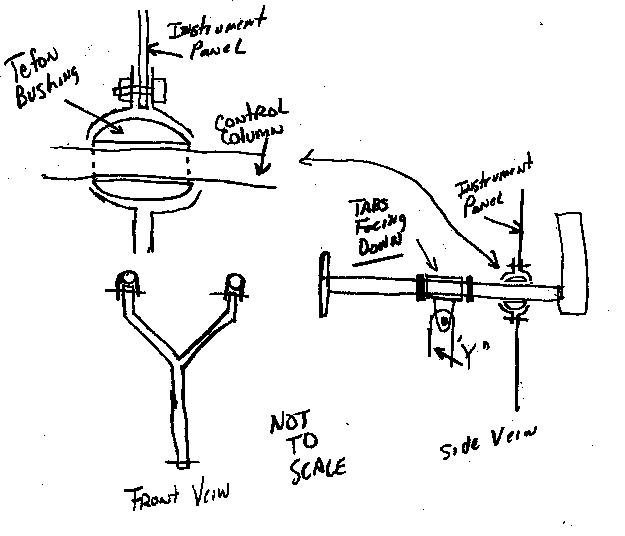
Now I'm back pedalling a bit on the control columns. It turns out I have collapsing columns, and I'm Ok in my mounting. I have removed the elevator cables as they were just too stiff. I have turned the tabs down and bolted a piece of thin steel between the two. There is some follow/lead torque happening, but the columns travel together and are much smoother then the previous configuration.
Gauges update.
I have almost completed an airspeed indicator. I started with an actual airspeed indicator from an unknown plane (range 0-220 knots, most color bands removed). I removed the brass pressure chamber. The 2 bolts that held the chamber happen to fix a standard servo exactly! I then solders a long piece of stiff copper wire to the little arm that used to 'rest' on the chamber. This wire is bent to fit into a small hole I drilled into the servo cam (close to the shaft to make movement as small as possible). The back of the case has been cut out to make room for the servo. Now I just need to calibrate the unit. This will be done by running a small routine that lets me 'step' one at a time until the needle points to a division. I'll then record the appropriate positions for each knot in a lookup table. (See the software page for sample code.)
March 22, 2001
Well, I've learned alot about how control columns are assembled inside a Cessna - and boy way I way off. Thanks to correspondence with Ken Trager from the simpits mailing list, I now have some decent bitmaps describing how to connect a pair of control columns.
CAD drawings
Here is a zipped up TurboCAD drawing of my pit.
March 19, 2001
Created this site.
Status to date. I have an AMD K6-II 500 using an 800x600 LCD panel on an overhead projector (OHP) as my primary display. For input I have a basic 'fighter' style joystick from RadioShack, a set of CH-Pro Pedals connected to a Thrustmaster ACM Game Card.
For gauges and additional views I currently have a couple of old 486s networked using WideView software (see my software page for details). Believe it or not, the 486 is actually quite adequate for displaying the dash. Frame rates are suffecient (>10fps). The side views are another story (<5fps with all detail turned off).
Just started building version 2 (second complete restart - first attempt was a wood box containing a single yoke, throttle, flaps and trim) of my pit. This will be a close to scale, close to accurate Cessna 172.
The panel is framed and yokes installed. The yokes' aileron action is linked nicely, the elevator action is extremely stiff. The compass and attitude indicator are mounted (the attitude is non-functioning, the compass was when on the workbench). I have a bucket seat from some car thats close to being attached to the panel.
Pictures - large pictures, about 50K each with each page having 2 - 3 pictures. Just so you are warned.
- Frame construction.
- Connecting the control columns.
- Gauges working and under construction.
Pre - March 19, 2001
What started with an innocent purchase on eBay for some computer game controllers, has blown up out of control into an attempt to create a useful, and fun, simulator. My choice will be the C172S as flown on MS FS98. (My call sign will be C-MSFS :-). Here is a few photos of my early attempts, and current configuration. They are fairly large images, running at 1024x768 is recommended to avoid scrolling. At some point I'll get some better image manipulation software and will create smaller index images.
Back to the logbook.